
Main Courses
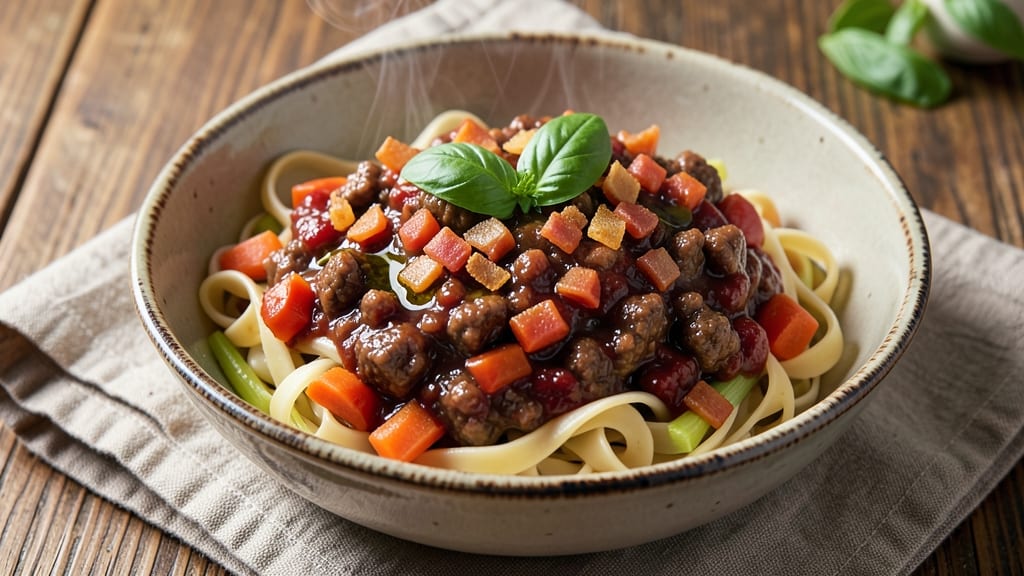
This authentic beef bolognese recipe brings the rich, slow-simmered flavors of Emilia-Romagna to your kitchen. The secret lies in the soffritto—finely diced onions, carrots, and celery—cooked low and slow with pancetta to develop deep, complex flavors before adding ground beef and tomatoes.
Unlike Italian-American versions, this ragù uses milk or cream to tenderize the meat and create that signature velvety texture.
What sets this recipe apart is the wine reduction and herb infusion, where white wine and fresh rosemary mellow into the sauce over hours, not minutes. The result is a sauce that’s rich, umami-packed, and balanced—never heavy or one-note.
Pairing it with perfectly cooked tagliatelle or pappardelle ensures every bite delivers that ideal al dente texture with a silky sauce clinging to each strand.
The key to authenticity is patience: simmering for at least 3 hours (or up to 5) transforms tough beef into tender, flavorful crumbles. The milk or cream isn’t just for richness—it breaks down proteins for a smoother sauce, while the tomato paste adds depth without overpowering.
This is the kind of bolognese that tastes like Nonna’s, not a shortcut from a jar.
Serve it with freshly grated Parmesan, a sprinkle of fresh basil, and a glass of Chianti for the full experience. The leftovers? Even better the next day as flavors meld further. Let’s get cooking—this is the bolognese your taste buds will remember.
Ingredients for authentic beef bolognese
Sixteen ingredients, five hours of simmering, and a sauce that tastes like Nonna's kitchen.
| Ingredient | Amount | Notes |
|---|---|---|
| Ground Beef (Chuck Roast) 🥩 | 2 ½ lb | 80% lean, finely ground preferred |
| Pancetta (or Guanciale) 🥓 | ½ lb | Diced, rind removed if available |
| Yellow Onions 🧅 | 2 whole | Finely diced, ~2 cups total |
| Carrots 🥕 | 2 whole | Finely diced, ~2 cups total |
| Celery Stalks 🌿 | 2 whole | Finely diced, ~2 cups total |
| Tomato Paste 🍅 | ½ cup | San Marzano preferred, no sugar added |
| Whole Milk (or Heavy Cream) 🥛 | ½ cup | Full-fat for optimal texture |
| Dry White Wine 🍷 | 1 cup | Pinot Grigio or Sauvignon Blanc |
| Crushed Tomatoes 🍅 | 2 cups | San Marzano preferred, no salt added |
| Fresh Rosemary 🌿 | ¼ cup | Finely chopped, stems removed |
| Fresh Basil 🌿 | ¼ cup | Chopped, for finishing only |
| Garlic Cloves 🧄 | 4 cloves | Finely minced, ~1 tbsp total |
| Extra-Virgin Olive Oil 🫒 | ½ cup | For sautéing soffritto |
| Parmesan Cheese 🧀 | ½ cup | Freshly grated, for serving |
| Tagliatelle or Pappardelle Pasta 🍝 | 1 ½ lb | Fresh or high-quality dried |
| Diamond Crystal Kosher Salt 🧂 | 1 ½ tsp | For seasoning during cooking |
| Freshly Ground Black Pepper 🌶️ | ½ tsp | For finishing |
The quality of your soffritto—onions, carrots, and celery—makes or breaks this dish. Look for fresh, firm vegetables with vibrant colors at Whole Foods or your local Italian market. The pancetta or guanciale should have a rich, pink hue and firm texture—avoid anything gray or slimy. For the tomato paste, San Marzano is non-negotiable; its natural sweetness and low acidity create the perfect base. The ground beef should be at least 80% lean—Costco or local butchers often carry the best quality chuck roast for grinding. Fresh herbs are essential: rosemary and basil should smell fragrant and bright, not wilted or dull. If you're short on time, dried herbs work at one-third the amount, but fresh delivers that authentic Italian aroma.
No pancetta? Substitute thick-cut bacon, but render the fat first to mimic the flavor. Running short on white wine? Dry vermouth or beef stock works in a pinch, though the acidity will differ slightly. The milk or cream can be swapped for coconut milk for a dairy-free option, though texture will vary. For tomato alternatives, high-quality crushed tomatoes in a jar (like Mutti) are better than canned—just drain excess liquid. The rosemary can be replaced with thyme or oregano at half the amount, but fresh basil is irreplaceable for that final bright note. If you're using dried pasta, Barilla or De Cecco brands hold up best to the rich sauce.
This ragù tastes even better the next day as flavors meld further. Store in an airtight container in the fridge for up to 5 days or freeze for 3 months in portion-sized containers. For the soffritto base, you can prep it a day ahead and refrigerate—it develops deeper flavors overnight. The fresh basil should be added just before serving to preserve its vibrant color. When reheating, add a splash of water or milk to prevent drying. For serving, always use freshly grated Parmesan—pre-grated clumps and loses flavor quickly. Portion the sauce into individual containers with a side of al dente pasta for easy meal prep.
Why You'll Love This Recipe
- One-Pot Magic: I swear by this recipe because it’s all in one pot—no chopping boards, no extra pans. Just brown the pancetta with the beef, toss in the onions, carrots, and celery (that classic soffritto), and let it simmer. Honestly, the hardest part is waiting for it to thicken.
- Umami Bomb: That pancetta (or guanciale) is the secret weapon—it renders down into crispy bits while infusing the beef with salty, fatty richness. Between us, the slow cook makes the ground chuck tender and the tomatoes meld into something deep and savory. Not your average jarred sauce vibes.
- Leftovers That Don’t Suck: This stuff tastes better the next day—yes, really. I make a big batch on Sundays, freeze half, and pull it out for lazy nights or when company drops by. Reheat it with a splash of water, and it’s like fresh again. (My roommate still asks for seconds, even after three helpings.)
- Budget-Friendly Luxury: Chuck roast is cheap, pancetta stretches far, and the veggies are pantry staples. For what feels like a fancy Italian meal, you’re spending less than takeout. Plus, the flavor is so bold it tricks people into thinking you slaved over it. (Spoiler: You didn’t.)
Step-by-step instructions for authentic beef Bolognese
This method delivers deep, complex flavors through slow cooking and proper technique.
Build the Soffritto Base
Heat the 0.5 cup extra-virgin olive oil in a large Dutch oven over medium-low heat. Add the 0.5 lb diced pancetta and cook for 5-6 minutes until the fat renders and the pancetta becomes golden and crispy. Remove the pancetta with a slotted spoon and set aside, leaving the rendered fat in the pot.
In the same pot, add the 2 whole finely diced yellow onions, 2 whole finely diced carrots, and 2 whole finely diced celery stalks. Cook for 10-12 minutes until the vegetables soften and the onions become translucent. This slow cooking develops their natural sweetness, which forms the flavor foundation of the sauce.
Develop the Flavor with Wine and Tomatoes
Add the 4 cloves finely minced garlic and cook for 30 seconds until fragrant. Pour in the 1 cup dry white wine and scrape up any browned bits from the bottom of the pot with a wooden spoon. Let the wine simmer for 3-4 minutes until reduced by half, which intensifies its flavor.
Stir in the 0.5 cup tomato paste and cook for 2 minutes until it darkens slightly. Add the 2 cups crushed tomatoes and bring to a gentle simmer. Season with 1.5 tsp diamond crystal kosher salt and 0.5 tsp freshly ground black pepper, then stir in the 0.25 cup finely chopped fresh rosemary. This step creates the rich, velvety texture that defines a proper Bolognese.
Cook the Meat and Finish the Sauce
Add the 2.5 lb ground chuck roast and the reserved crispy pancetta to the pot. Stir to combine and cook for 5 minutes until the meat loses its raw appearance. Pour in the 0.5 cup whole milk and stir well to distribute evenly. This step is crucial—it tenderizes the meat and adds a subtle richness to the sauce.
Reduce the heat to low and cover the pot. Simmer for 2.5-3 hours, stirring occasionally, until the sauce thickens and the meat becomes tender. The sauce should coat the back of a spoon and have a deep, concentrated flavor. If it becomes too thick, add 2-3 tablespoons of water to maintain the proper consistency.
Prepare and Serve the Pasta
Bring a large pot of water to a rolling boil and add 1.5 lb tagliatelle or pappardelle pasta. Cook until 1 minute before al dente according to package instructions. Reserve 1 cup pasta water before draining.
Toss the drained pasta with the Bolognese sauce, adding reserved pasta water as needed to create a creamy, cohesive sauce. Serve immediately, garnished with 0.25 cup chopped fresh basil and 0.5 cup freshly grated parmesan cheese. The pasta should be perfectly al dente, allowing the rich Bolognese to cling beautifully to each strand.
Pro Tips For Making Authentic Beef Bolognese
- Crank the Heat First: High heat for pancetta and onions—no, really, get that pan smoking. I used to simmer gently and wondered why my soffritto tasted bland; now I blister the pancetta until it’s crispy and the onions caramelize in 8-10 minutes. (Yes, even if you’re impatient like me.)
- Dice Small, Dice Often: The carrots and celery should be tiny—think rice grains, not dime-sized chunks. I learned this the hard way when my bolognese had visible vegetable bits after hours of cooking. Use a sharp knife and don’t rush; this is where flavor hides.
- Don’t Rush the Render: Let the ground chuck cook slow after the pancetta comes out—20 minutes minimum, stirring occasionally. Skipping this step means your sauce will taste raw and greasy. (Your future self will thank you for resisting the urge to speed it up.)
- Stir the Pot: Bolognese isn’t a set-it-and-forget-it dish. Stir every 5-10 minutes, especially in the first 30 minutes, to prevent sticking and even out the browning. I used to walk away, and the bottom would seize—now I set a timer. (Does it look weird? Yes. Does it work? Every single time.)
Essential equipment for great authentic beef bolognese
Dutch Oven Essentials
A 5-7 quart Dutch oven is non-negotiable for this recipe—it provides even heat distribution and enough capacity for the long simmer. I swear by Le Creuset’s Signature Dutch Oven (28cm) for its durability and heat retention, but All-Clad’s Stoneware Dutch Oven is a great alternative if you prefer stovetop-to-oven versatility.
Avoid nonstick pans; they can’t handle the prolonged cooking time without releasing harmful fumes. 🔥
Knife and Cutting Tools
Precision matters when dicing the soffritto (onions, carrots, celery) into ¼-inch cubes. A sharp chef’s knife (like Wüsthof’s Classic 8-inch) paired with a mandoline for even slices will save you time.
For the pancetta, a serrated knife helps cut through the fat cleanly. I keep my knives honed with a Sharpie Sharpening Stone—a dull knife is more dangerous than a sharp one!
Measuring and Mixing
Use a stainless steel measuring cup (like OXO’s Good Grips) for the tomato paste, milk, and wine to avoid plastic flavors. A wooden spoon is ideal for stirring the sauce—it won’t scratch the Dutch oven like metal.
For the wine reduction, a small saucepan (like Tramontina’s Tri-Ply) lets you monitor the reduction closely. Pro tip: Skim excess fat from the pancetta with a slotted spoon before adding the meat.
Thermometer for Precision
While not mandatory, a meat thermometer (I use Thermoworks’ Smoke) helps track the sauce’s temperature during the long simmer. Aim for 195–205°F—this ensures the meat is tender without breaking down into mush.
If you’re new to Dutch ovens, a laser thermometer (like Kizen’s) lets you check temps without opening the lid and losing heat. 🌡️
Pasta Tools
For the pasta, a colander with long handles (like Chicago Metallic’s) prevents spills when draining, and a pasta fork (or tongs) helps toss the sauce evenly. If using fresh pasta, a rolling pin and pasta machine (like Imperia’s) are worth the investment—homemade tagliatelle elevates the dish.
Store-bought? De Cecco or Barilla hold up beautifully to the rich sauce.
Garnish and Serve
Fresh basil and Parmesan deserve proper tools: a small pair of kitchen shears for quick basil chopping and a microplane for freshly grated Parmesan (pre-grated loses flavor fast). Serve in deep, warm bowls (like Corelle’s Stoneware) to keep the sauce at its best.
A carving fork helps portion the crispy pancetta on top for that restaurant-worthy finish. ✨
Nutrition facts
Frequently asked questions
Why does this recipe use milk or cream in the sauce?
The milk or cream isn't just for richness—it tenderizes the meat by breaking down proteins and creates that signature velvety texture. Traditional Italian Bolognese uses just enough to mellow the acidity of tomatoes while adding subtle sweetness. For a lighter version, try whole milk instead of heavy cream.
Can I make this sauce in a slow cooker?
Yes, but with adjustments! Brown the meat and soffritto first in a skillet, then transfer everything to a 6-quart slow cooker on low for 6-8 hours. Add ½ cup water if it gets too thick. The slow cooker method works well for working parents—just skip the wine reduction step to avoid alcohol evaporation.
What's the difference between Bolognese and meat sauce?
Authentic Bolognese is a slow-cooked ragù with ground chuck, milk, and a delicate balance of herbs—never overpowered by tomatoes. Italian-American "meat sauce" often uses ground beef, more tomatoes, and spices like oregano. This recipe stays true to Emilia-Romagna tradition with its soffritto base and wine reduction.
How do I fix a sauce that's too thick or too thin?
For a thick sauce, add 2-3 tablespoons of water or milk while stirring. If too thin, simmer uncovered for 10-15 minutes to reduce. Never rush this—authentic Bolognese should coat the back of a spoon but remain silky, not gluey. The long simmer time helps achieve the perfect consistency naturally.
Can I use ground turkey instead of beef?
While possible, ground turkey will be much leaner and may dry out during the long simmer. If substituting, use 85% lean ground turkey and add 1 extra tablespoon of milk to compensate. For best results, stick with beef chuck—its fat content creates that rich, meaty texture.